
Virtual Dispersive Networking Market to Reach USD 27.1 Billion by 2032 Driven by Cybersecurity and Cloud Connectivity Demand | Research by SNS Insider
Virtual dispersive networking market grows on rising need for secure, low-latency networking across cloud, hybrid, and remote enterprise environments.
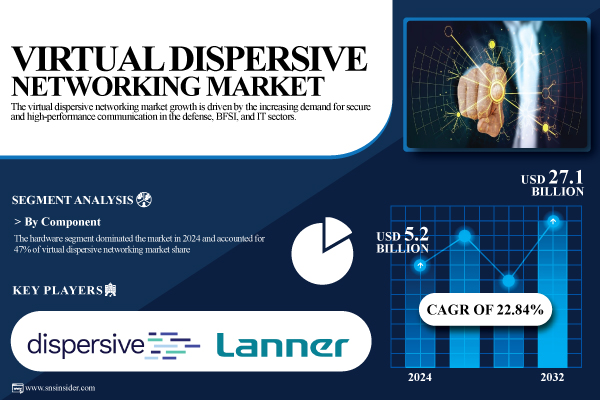
Austin, Aug. 19, 2025 (GLOBE NEWSWIRE) — The Virtual Dispersive Networking (VDN) Market was valued at USD 5.2 billion in 2024 and is projected to reach USD 27.1 billion by 2032, expanding at a CAGR of 22.84% from 2025 to 2032.
This strong growth is fueled by the rising demand for secure, high-performance networking solutions across sectors such as defense, finance, and healthcare. As cyber threats become more advanced, organizations are increasingly adopting VDN to ensure encrypted, resilient data transmission. The market is also driven by remote work expansion, digital transformation initiatives, and the need for low-latency, scalable networking infrastructure, especially across hybrid and multi-cloud environments.
Download PDF Sample of Virtual Dispersive Networking Market @ https://www.snsinsider.com/sample-request/7158
The U.S. virtual dispersive networking market is projected to grow from USD 3.19 billion in 2024 to USD 9.65 billion by 2034, registering a robust CAGR of 12.33%.
This growth is driven by increasing cybersecurity concerns, rising adoption of cloud services, and growing demand for secure, high-speed communication across defense, finance, and enterprise sectors amid expanding remote and hybrid work environments.
Key Players:
- Dispersive Networks
- Lanner Electronics
- 6WIND
- Viavi Solutions
- Metaswitch Networks
- Juniper Networks
- Ribbon Communications
- Overture Networks
- Cisco Systems
- VMware
Virtual Dispersive Networking Market Report Scope:
| Report Attributes | Details |
| Market Size in 2024 | USD 5.2 Billion |
| Market Size by 2032 | USD 27.1 Billion |
| CAGR | CAGR of 22.84% From 2025 to 2032 |
| Base Year | 2024 |
| Forecast Period | 2025-2032 |
| Historical Data | 2021-2023 |
| Report Scope & Coverage | Market Size, Segments Analysis, Competitive Landscape, Regional Analysis, DROC & SWOT Analysis, Forecast Outlook |
| Key Segments | • By Component (Hardware, Software, Services) • By Deployment Model (On-Premises, Cloud-Based) • By Organization Size (Small Offices [1–9 employees], Small Enterprises [10–99 employees], Medium-sized Enterprises [100–499 employees], Large Enterprises [500–999 employees], Very Large Enterprises [1,000+ employees]) • By End-Use (BFSI, Healthcare, Government and Defense, IT and Telecommunication, Manufacturing) |
If You Need Any Customization on Virtual Dispersive Networking Market Report, Inquire Now @ https://www.snsinsider.com/enquiry/7158
By Component, Hardware Segment Leads Virtual Dispersive Networking Market in 2024 Due to Rising Demand for High-Speed, Secure Infrastructure
In 2024, the hardware segment held the largest share of the virtual dispersive networking market, accounting for 47%. This dominance is attributed to growing demand for high-performance networking devices like routers and security appliances. The segment continues to expand, fueled by increasing infrastructure investments and heightened cybersecurity concerns across enterprise and government networks.
By Deployment Model, On-Premises Deployment Dominates Virtual Dispersive Networking Market in 2024 Amid Rising Demand for Control, Security, and Compliance
The on-premises segment led the virtual dispersive networking market in 2024, capturing 62% of the revenue share. This dominance is driven by organizations prioritizing control, customization, and data security. Sectors such as government, healthcare, and finance favor on-premises setups due to strict compliance mandates and the need for secure, low-latency data transmission.
By Organization Size, Small Enterprises Expected to Witness Fastest Growth in Virtual Dispersive Networking Market Due to Cybersecurity Focus and Cloud Adoption
Small enterprises are projected to grow at the fastest pace in the virtual dispersive networking market, driven by rising cybersecurity awareness, increasing cloud adoption, and the need for cost-effective, flexible solutions. The shift toward digital operations and remote work fuels demand for simple, scalable VDN deployments that support agility and secure connectivity.
By End-Use, IT and Telecommunication Sector Leads Virtual Dispersive Networking Market in 2024 Driven by Demand for Secure, Scalable, Low-Latency Connectivity
In 2024, the IT and telecommunication segment held a major share of the virtual dispersive networking market, driven by growing needs for high-speed, secure communication. With rapid expansion of data centers, cloud infrastructure, and 5G networks, the industry increasingly invests in VDN to ensure stable, encrypted, and low-latency global connectivity.
North America Leads Virtual Dispersive Networking Market, Asia Pacific Set to Record Fastest Growth
In 2024, North America held 41% of the virtual dispersive networking market share, driven by advanced IT infrastructure, high cybersecurity spending, and early adoption of networking technologies. The region’s dominance is reinforced by strong demand from BFSI, healthcare, and defense sectors, as well as the presence of key industry players continually innovating in secure networking solutions.
Asia Pacific is poised to witness the fastest CAGR in the virtual dispersive networking market, led by rapid digitalization, rising cloud adoption, and expanding 5G infrastructure. Countries like India and Southeast Asian nations are investing heavily in secure, scalable network systems. These trends are shaping region-specific strategies and making Asia Pacific a key hub for VDN deployment and innovation.
Buy Full Research Report on Virtual Dispersive Networking Market 2025-2032 @ https://www.snsinsider.com/checkout/7158
Market USP’s
• USP 1 – VDN vs. Traditional VPN & SD-WAN Comparative Analysis
Helps clients understand the performance, security, and cost advantages of VDN over legacy networking solutions to support next-gen infrastructure decisions.
• USP 2 – Cybersecurity Threat Mitigation Framework with VDN
Enables clients to assess how VDN strengthens data privacy and zero-trust security posture against evolving threats like DDoS and deep packet inspection.
• USP 3 – Industry-Specific Adoption Readiness Map
Guides vertical-focused strategy by highlighting sectors (e.g., BFSI, defense, healthcare) with high urgency and readiness for VDN deployment.
• USP 4 – Latency, Throughput & Reliability Benchmarks Across Geographies
Provides technical performance insights for clients seeking to deploy secure and resilient global connectivity.
• USP 5 – Integration Matrix with Cloud, SASE, and IoT Environments
Helps enterprises plan seamless VDN adoption by identifying compatibility with existing cloud, edge, and hybrid network architectures.
• USP 6 – Total Cost of Ownership (TCO) & ROI Modelling for VDN Deployment
Supports investment decisions by illustrating long-term savings, risk reduction, and operational gains from VDN adoption.
• USP 7 – Vendor Capability Scorecard: Protocol Innovation, Scalability, Compliance
Aids in vendor evaluation by comparing technical depth, compliance readiness, and scalability of VDN platforms.
About Us:
SNS Insider is one of the leading market research and consulting agencies that dominates the market research industry globally. Our company’s aim is to give clients the knowledge they require in order to function in changing circumstances. In order to give you current, accurate market data, consumer insights, and opinions so that you can make decisions with confidence, we employ a variety of techniques, including surveys, video talks, and focus groups around the world.
CONTACT: Jagney Dave - Vice President of Client Engagement Phone: +1-315 636 4242 (US) | +44- 20 3290 5010 (UK) Email: info@snsinsider.com
 Disclaimer: The above press release comes to you under an arrangement with GlobeNewswire. SingaporeOutlook.com takes no editorial responsibility for the same.