
Leather Chemicals Market to Reach USD 15.15 Billion by 2032 | Growth Driven by Rising Demand for High-Quality Leather in Automotive, Footwear, and Upholstery Applications
The global leather chemicals market is witnessing robust growth, driven by rising consumer preference for premium leather products across various end-use industries, including automotive, footwear, furniture, and fashion.
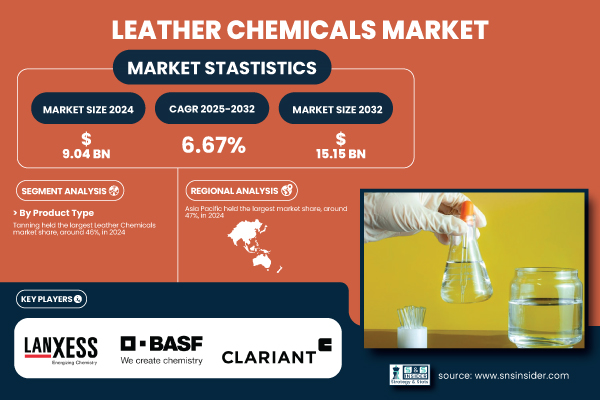
Austin, July 07, 2025 (GLOBE NEWSWIRE) — The global leather chemicals market was valued at USD 9.04 billion in 2024 and is projected to reach USD 15.15 billion by 2032, expanding at a compound annual growth rate (CAGR) of 6.67% from 2025 to 2032.
The leather chemicals market is growing steadily with the rising global demand for quality leather in industries such as footwear, automotive, furniture, and fashion. Due to the rising demand for durable, supple, and visually superior leather products among consumers, manufacturers are extensively using high-end chemical treatments to improve leather properties, including physical properties, softening, water and heat resistance, scratch and abrasion resistance, etc. Furthermore, the increased disposable income, especially in developing countries, has resulted in a higher consumption of leather goods, giving rise to the demand for efficient processing chemicals.
The U.S Leather Chemicals market size was USD 1.49 billion in 2024 and is expected to reach USD 2.79 billion by 2032 and grow at a CAGR of 8.11% over the forecast period of 2025-2032. It is due to the presence of a strong industrial base, high demand for luxury leather goods, and the development of an advanced manufacturing facility. The country is a leading player in the automobile and footwear industries, which manufacture high-performance leather that has been chemically treated for optimum durability, comfort, and appearance.
Download PDF Sample of Leather Chemicals Market @ https://www.snsinsider.com/sample-request/7297
Key Players:
- Lanxess AG
- Stahl Holdings B.V.
- BASF SE
- TFL Ledertechnik GmbH
- Sisecam Chemicals
- Clariant AG
- Schill+Seilacher GmbH
- Elementis plc
- DyStar Group
- Zschimmer & Schwarz GmbH & Co KG
Leather Chemicals Market Report Scope:
| Report Attributes | Details |
| Market Size in 2024 | USD 9.04 Billion |
| Market Size by 2032 | USD 15.15 Billion |
| CAGR | CAGR of 6.67% From 2025 to 2032 |
| Base Year | 2024 |
| Forecast Period | 2025-2032 |
| Historical Data | 2021-2023 |
| Report Scope & Coverage | Market Size, Segments Analysis, Competitive Landscape, Regional Analysis, DROC & SWOT Analysis, Forecast Outlook |
| Key Drivers | • Growing Automotive Sector Using Leather Interiors Drives Market Growth. |
If You Need Any Customization on Leather Chemicals Market Report, Inquire Now @ https://snsinsider.com/enquiry/7297
By Product Type
In 2024, tanning emerged as the leading category, capturing around 46% of revenue share of the entire leather chemicals market. This dominance arises mainly from the fact that tanning is essential for the functional conversion of raw hides into physical stable (non-decomposing) hide after stabilizing collagen fibers. The tanning agents, which are mostly chromium-based but more and more are chrome-free or vegetable-based, are vital for making leather soft, strong, and resistant to moisture and heat. As global leather goods production continues to rise, and with increased inter-industry demand for quality and durable materials in footwear, automotive and furniture industries, the demand for tanning agent has increased.
By End-Use Industry
The largest market share in the leather chemicals market is attributable to the footwear segment and stood at 32% of the global revenue in 2024. Such leadership is dictated by the global appetite for leather shoes, sandals, and boots, notably emerging markets where populations are increasing and per capita disposable income is beginning to rise. A number of chemical treatments are involved during processing, such as tanning, softening, dyeing, and finishing of leather footwear to achieve properties like durability, comfort, waterproofness, and aesthetics.
Regional Analysis
Asia-Pacific
In 2024, the Asia Pacific market segment was a predominant holder with a leather chemicals market share of approximately 47% of the world’s revenues. This dominance is due to the fact that the region has a robust leather manufacturing base, with a leading share in the production and exports of leather and leather goods, specifically to countries such as China, India, Bangladesh, and Vietnam. The production growth in the region can be attributed to the abundance of raw material, cheap labor, and favorable government policies regarding the leather sector. Furthermore, the increased utilization of leather chemicals is due to the rising domestic demand for leather goods is booming in products such as shoes, automotive interiors, fashion-related items, etc.
Recent Developments
• In March 2025, Stahl Holdings B.V. launched a renewable carbon-based line of finishing chemicals to reduce the carbon footprint of leather processing without compromising performance in terms of production or durability.
• In Aug 2024, BASF SE signed an agreement with a leading Italian luxury leather goods company to develop and supply customized sustainable tanning and softening chemicals.

Buy Full Research Report on Leather Chemicals Market 2025-2032 @ https://www.snsinsider.com/checkout/7297
About Us:
SNS Insider is one of the leading market research and consulting agencies that dominates the market research industry globally. Our company’s aim is to give clients the knowledge they require in order to function in changing circumstances. In order to give you current, accurate market data, consumer insights, and opinions so that you can make decisions with confidence, we employ a variety of techniques, including surveys, video talks, and focus groups around the world.
CONTACT: Jagney Dave - Vice President of Client Engagement Phone: +1-315 636 4242 (US) | +44- 20 3290 5010 (UK)
 Disclaimer: The above press release comes to you under an arrangement with GlobeNewswire. SingaporeOutlook.com takes no editorial responsibility for the same.