
Twenty-Five Years After the Gujarat Earthquake: A template for School Safety
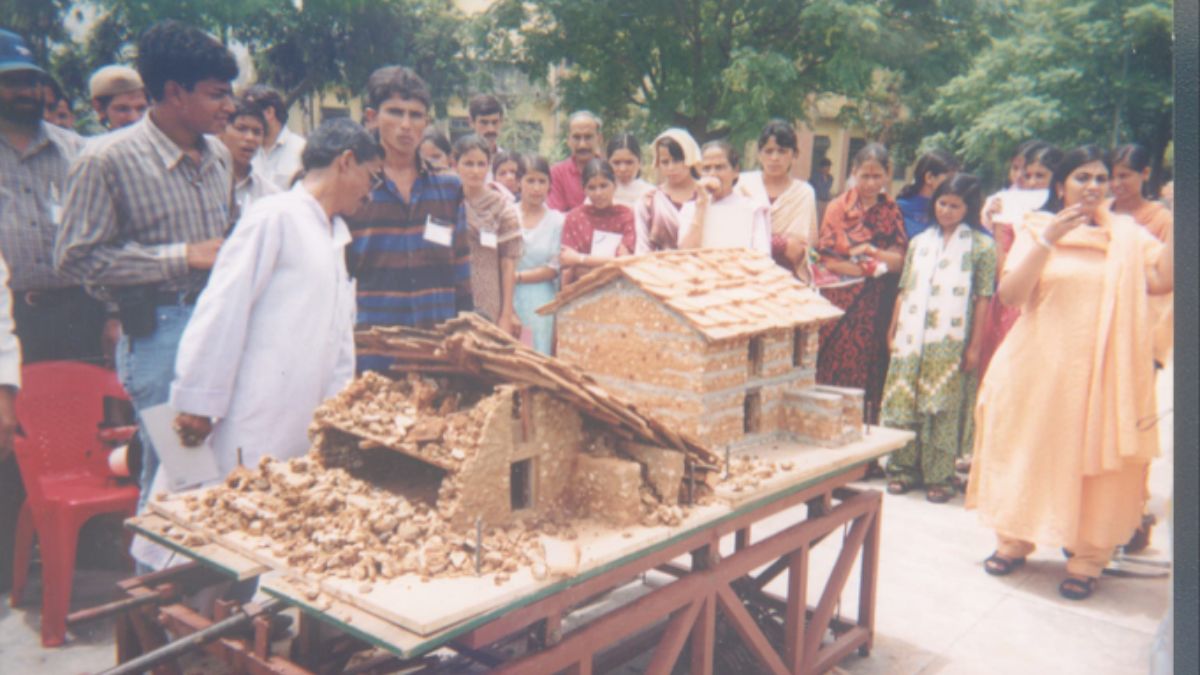
On the morning of January 26, 2001, as India marked Republic Day, a powerful earthquake struck Gujarat. Measuring 7.7 on the Richter scale, the tremor flattened towns, ruptured infrastructure, and claimed more than 20,000 lives. Entire neighbourhoods in Bhuj, Anjar, Bhachau and surrounding districts were reduced to rubble within seconds. What followed was one of the country’s most complex humanitarian crises, revealing both the scale of India’s seismic risk and the fragility of its built environment.
The Gujarat earthquake was not just a disaster. It was a structural failure. Thousands of homes, hospitals, schools and public buildings collapsed because they were not designed to withstand seismic forces. In many places, reinforced concrete behaved like brittle material, crushing occupants instead of protecting them. For a generation of survivors, the earthquake left physical scars, economic losses and psychological trauma that lasted long after the debris was cleared.
The impact went beyond Gujarat. The disaster became a turning point for India’s disaster management ecosystem. It triggered reforms in building codes, emergency response protocols and rehabilitation planning. Institutions were strengthened, technical standards were revised, and disaster risk reduction entered policy conversations more seriously than ever before. Yet, twenty-five years later, the most uncomfortable truth remains: many of the risks exposed in 2001 still exist today.
Nowhere is this more evident than in schools.
During the earthquake, hundreds of school buildings collapsed or were severely damaged. Many were non-engineered structures, built without seismic considerations, even though Gujarat lies in one of India’s most earthquake-prone zones. Classes resumed in temporary shelters, under tin roofs and tarpaulins, while families struggled to rebuild their lives. For children, education was disrupted at a moment when stability mattered most.
In the years that followed, rebuilding schools became a priority. But reconstruction alone was not enough. The disaster highlighted a deeper issue: school safety is not only about buildings, but about preparedness, awareness and systems. A structurally strong school is still unsafe if teachers and students do not know how to respond during an earthquake, if evacuation routes are unclear, or if regular safety drills are absent.
India has more than 1.5 million schools, many located in seismic zones, floodplains, cyclone-prone coasts and landslide-risk areas. Yet disaster preparedness is still unevenly integrated into the education system. While policies exist, implementation often depends on local capacity, funding and awareness. As a result, children remain one of the most vulnerable groups during disasters.
This is where long-term, community-rooted work becomes critical.
In the aftermath of the Gujarat earthquake, SEEDS worked alongside affected communities on recovery and reconstruction efforts, including rebuilding safer schools and promoting disaster-resilient practices. Over time, the organisation expanded its focus beyond response, working on preparedness, school safety audits, teacher training and child-centred disaster risk reduction. The aim was simple but ambitious: to ensure that schools become places of safety, not sites of tragedy, when disasters strike.
The non-profit’s approach recognised that safety cannot be delivered as a one-time intervention. It requires continuous engagement with children, educators, engineers and local authorities. Training teachers to act as first responders, educating students on basic risk awareness, and strengthening school management systems are as important as retrofitting walls or columns. When children understand risk, they also become powerful messengers of safety within their families and communities.
Twenty-five years Gujarat, the relevance of these lessons has only grown. India has witnessed major earthquakes since 2001, from Kashmir to Sikkim, alongside floods, cyclones and heatwaves that increasingly disrupt schooling. Climate change is amplifying existing risks, while rapid urbanisation often prioritises speed over safety. In this context, schools sit at the intersection of risk and responsibility.
School safety must move from being a project-based initiative to a core part of educational planning. This means investing in safer construction, yes, but also embedding disaster preparedness into curricula, teacher training and school governance. It means regular safety drills that are taken seriously, clear accountability for building standards, and inclusive planning that considers children with disabilities.
SEEDS continues to work with governments, schools and communities to strengthen these systems, drawing on lessons from Gujarat and subsequent disasters. But the responsibility cannot rest with any single institution. Protecting children requires collective commitment – from policymakers who set standards, from engineers who design structures, from educators who shape behaviour, and from communities who demand safety as a right.
Twenty-five years ago, the Gujarat earthquake forced India to confront its vulnerability. Today, it offers an opportunity to measure how far we have come – and how far we still need to go. If the legacy of that day is to mean anything, it must be reflected in schools that stand firm, children who know how to respond, and systems that prioritise safety before tragedy strikes.