
Lithium-ion Battery Market Size to Surpass USD 416.96 Bn by 2035
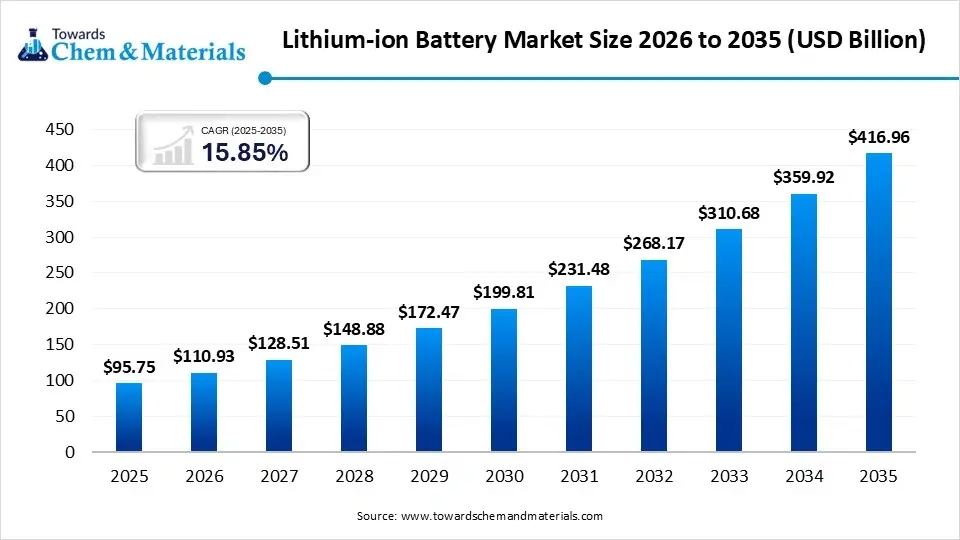
The global lithium-ion battery market size is expected to grow from USD 110.93 billion in 2026 to USD 416.96 billion in 2035, growing at a CAGR of 15.85% from 2026 to 2035. The top key players in the market are Contemporary Amperex Technology Co., Limited (CATL), LG Energy Solution Ltd., Panasonic Corporation, Northvolt AB, AESC Group, BYD Co., Ltd., CALB (China Aviation Lithium Battery Co., Ltd.), EVE Energy Co., Ltd., Samsung SDI Co., Ltd., SK On Co., Ltd., Tesla, Inc., Toshiba Corporation -Global Forecast 2026 To 2035
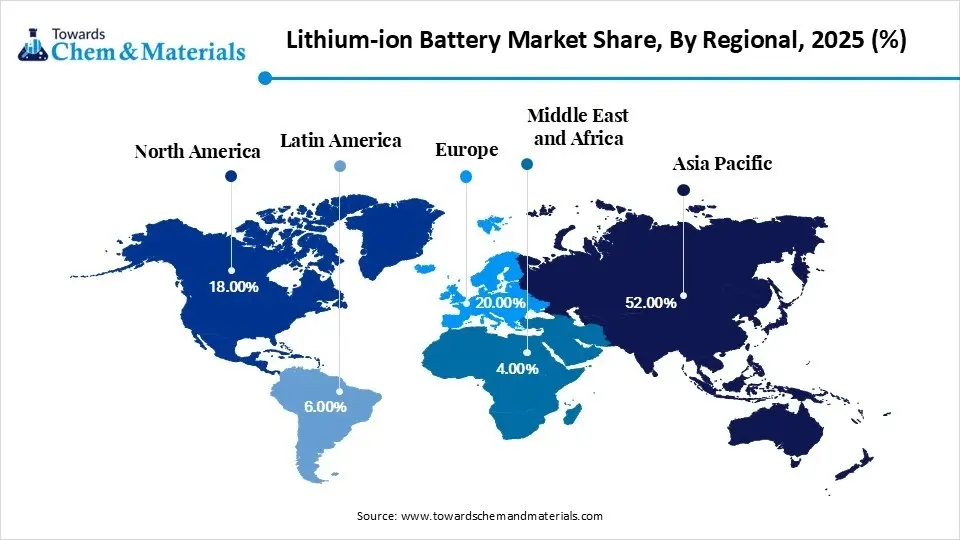
Ottawa, April 24, 2026 (GLOBE NEWSWIRE) — According to Towards Chemicals and Materials Analytics and Consulting, the global lithium-ion battery market size was valued at USD 95.75 billion in 2025. The market is projected to grow from USD 110.93 billion in 2026 to USD 416.96 billion by 2035 at a CAGR of 15.85% during the forecast period 2026-2035 Asia Pacific dominated the lithium-ion battery market with the largest revenue share of 52% in 2025. The lithium-ion battery market is growing rapidly due to rising electric vehicle demand, renewable energy adoption, and improved battery efficiency, making it a key component of the global clean energy transition. A study published by Towards Chemical and Materials a sister firm of Precedence Research.
Don’t miss out on business opportunities in Lithium-ion Battery Market. Speak to our analyst and gain crucial industry insights that will help your business grow. {Download a Sample Report Here@ https://www.towardschemandmaterials.com/download-sample/ 6301 }
Lithium-ion Battery Market Report Highlights
- Asia Pacific dominated the market share 52% in 2025. The presence of raw materials in the regions supports growth.
- By region, North America is expected to have the fastest growth in the market in the forecast period between 2026 and 2035. The growing demand from the automotive sector helps the growth.
- By battery type, the NMC segment dominated the market share 38.00% in 2025. The growing consumer demand for electronics fuels the growth.
- By battery type, the Lithium Iron Phosphate (LFP) segment is projected to grow at the fastest CAGR between 2026 and 2035. growth is supported by LFP’s superior safety, long life cycle, and low cost, fueling the growth of the market.
- By application, the consumer electronics segment dominated the market share 48.00% in 2025. Growing demand for EVs, government incentives for battery manufacturing, fuel the growth of the market.
- By application, the energy storage segment is projected to grow at the fastest CAGR between 2026 and 2035. The need to manage intermittent renewable energy and enhanced grid reliability fuels the growth.
Request Research Report Built Around Your Goals: sales@towardschemandmaterials.com
Is Demand for Sterile Injectable Products Driven by Lithium-ion Battery?
Electric Vehicles (EV) are a key contributor to the rapidly increasing need for lithium-ion batteries. The growth in the lithium-ion battery market is largely due to the global expansion of EVs and the introduction of stricter emissions regulations in use around the world, which encourages consumers to transition to cleaner modes of transportation through incentives such as rebates. As leading manufacturers like Tesla and BYD continue to expand production amping up the need for high-performance lithium-ion batteries, other technology developments, such as improved energy density, faster charging speeds and reduced costs for lithium-ion batteries, are helping to make their use very appealing to a wider range of users. In parallel to this, the increasing emphasis on utilizing renewable energy to support battery storage, such as powering homes with solar or wind energy, supports continued demand as these same batteries will help stabilize the supply of electricity to the consumer electrical grid and supply the electricity needed for variable outputs or demands from residential and industrial users.
Why lithium-ion batteries are important
Lithium-ion batteries are crucial for transitioning to a more sustainable and energy-efficient future. With their high energy density, long lifespan, and rechargeable capabilities, they outperform many other battery types. Unlike traditional lead-acid or nickel-cadmium batteries, lithium-ion batteries are lighter, more efficient, and capable of storing more energy in a compact size. This efficiency is vital as we strive to reduce our carbon footprint and embrace renewable energy sources.
Applications of lithium-ion-batteries
The advantages of lithium-ion batteries and their decreasing cost have led to a proliferation of their use in many areas:
- Emergency power systems : In critical installations, such as server farms, the batteries of a UPS (Uninterruptible Power Supply) protect you from the loss or instability of the electricity supply.
- Solar energy storage: Solar energy storage is intermittent and these batteries are best suited to solar panels because of the way they charge and their speed, especially for self-consumption.
- Consumer electronics and mobile devices : Mobile devices have become the main application for these batteries, allowing for ever-increasing miniaturisation.
- Disability assistance : These types of batteries are present in electric wheelchairs, stair lifts or motorised prostheses, making life easier for people with mobility restrictions.
Lithium-ion batteries for electric vehicles
The development and increasing adoption of electric and hybrid vehicles is largely due to the efficiency and lower cost of lithium-ion batteries. In addition to having a high energy density compared to their size, their mass production has brought the price of electric vehicles closer to petrol-powered vehicles. In terms of operating costs, the price of electricity to run an electric vehicle is lower than the cost of fuel for internal combustion engines. Also provide autonomy for longer and longer journeys.
The storage of the future
The shortage of cobalt, a necessary material to manufacture them, and the difficulties in recycling it are driving research into alternative battery technologies. Here are some of the most promising:
- Hydrogen cells: these batteries produce electricity from gaseous hydrogen, but the drawback is in being ab to make green hydrogen without resorting to fossil fuels, not the technology itself.
- Solid-state batteries: use solid instead of liquid or gel electrolytes. They have a higher energy density, reduce the risk of explosion and fire and take up less space because they don’t require as many safety-related components.
- Graphene supercapacitors: Capacitors can be charged and discharged more efficiently than a battery and the use of graphene could achieve energy densities similar to current batteries.
Lithium-ion Battery Market Opportunity
The lithium ion battery industry is experiencing tremendous opportunity as electrification in several industries increases rapidly and energy demands increase accordingly, including energy storage systems. Electric vehicle adoption is being driven by government incentives and stricter emissions regulations. As such, there is a need for energy storage systems that work with renewable energy sources on large scale.
Furthermore, advances in battery technology (e.g., solid state and fast charging) are providing improvements in performance and safety, and they will open up new application niches. In addition, with the ongoing growth in consumer electronics, the investment in battery recycling and second life use is creating long-term growth opportunities. Given these factors, the lithium ion battery industry has a very bright future ahead.
Immediate Delivery Available | Buy This Premium Research Report
https://www.towardschemandmaterials.com/checkout/6301
Lithium-ion Battery Market Report Scope
| Report Attribute | Details |
| Market Definition | The Lithium-ion Battery market represents the total revenue generated from the design, manufacturing, and deployment of lithium-ion battery cells, modules, packs, and energy storage systems across electric vehicles, consumer electronics, and stationary energy storage applications. |
| Market size value in 2026 | USD 110.93 Billion |
| Revenue forecast in 2035 | USD 416.96 Billion |
| Growth rate | CAGR of 15.85% from 2026 to 2035 |
| Base year for estimation | 2025 |
| Historical data | 2021 – 2025 |
| Forecast period | 2026 – 2035 |
| Quantitative units | Volume in GWh; revenue in USD million/billion, and CAGR from 2026 to 2035 |
| Report coverage | Volume & revenue forecast, competitive landscape, growth factors, and trends |
| Segments covered | By Product, By Application, By Component, By Capacity, By Voltage, By End-User, By Regions |
| Regional scope | North America; Europe; Asia Pacific; Latin America; Middle East & Africa |
| Country scope | U.S.; Canada; Mexico; Italy; U.K.; Germany; Spain; France; China; India; Japan; South Korea; Australia; Brazil; Paraguay; Columbia; South Africa; UAE; Egypt; Saudi Arabia |
| Key companies profiled | Contemporary Amperex Technology Co., Ltd. (CATL); LG Energy Solution Ltd.; Panasonic Holdings Corporation; Samsung SDI Co., Ltd.; BYD Co., Ltd.; SK On Co., Ltd.; Tesla, Inc.; CALB (China Aviation Lithium Battery Co., Ltd.); EVE Energy Co., Ltd.; Toshiba Corporation |
For more information, visit the Towards Chemical and Materials website or email the team at sales@towardschemandmaterials.com| +1 804 441 9344
Why Is the Lithium-ion Battery Market Dominated By Asia Pacific?
The Asia Pacific lithium ion battery market size was valued at USD 49.79 billion in 2025 and is expected to be worth around USD 218.90 billion by 2035, exhibiting at a compound annual growth rate (CAGR) of 15.96% over the forecast period from 2026 to 2035.
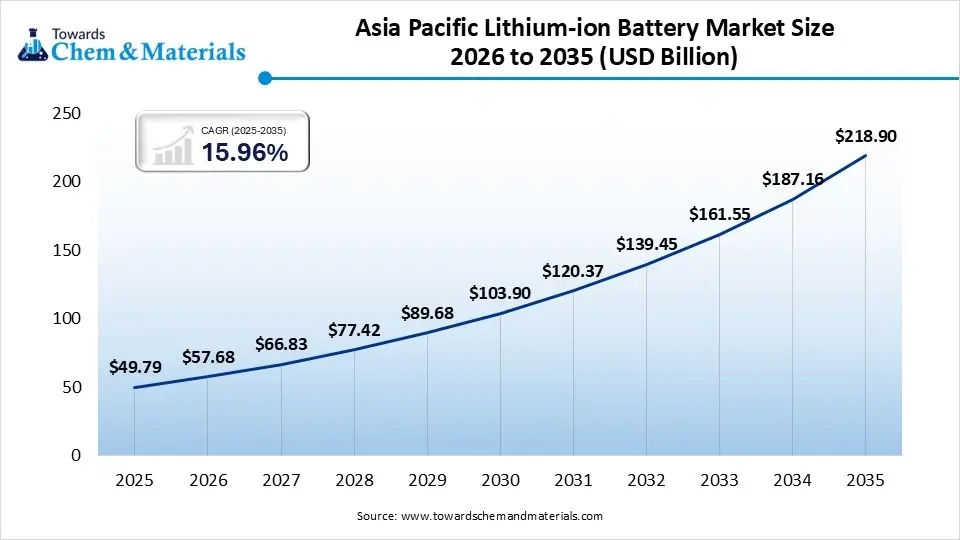
Asia Pacific held dominant position in the lithium battery market today, with a strong manufacturing ecosystem, an abundance of capability to process raw materials, and a significant amount of demand for electric vehicles as well as consumer electronics. There are many large-scale production facilities located throughout Asia Pacific that are primarily funded by either government incentives or policies that promote the development of battery manufacturers. In addition, the various battery manufacturers are continuously expanding their capacities, and therefore, the overall supply chain of the Asia Pacific lithium battery industry is strengthened. Investments in renewable energy storage, along with rapid urbanization, continue to drive strong demand in the Asia Pacific, making it the premier global market for lithium battery production and innovation.
How will North America Expand Fastest in the Lithium-ion Battery Market in forecasted?
North America lithium battery production is largely attributed to the increase of investments into domestic battery production/locations, along with electric vehicle adoption. Numerous government programmers are helping to create incentives for clean energy and local battery supply chain construction; this has resulted in the establishment of gig factories across the continent. All major automakers are also now involved with technology companies to secure their battery supply and reduce their dependence on imports. In addition, battery recycling technologies and energy storage systems are becoming more prevalent.
Europe Lithium-ion Battery Market Trends
The lithium-ion battery market in Europe is supported by aggressive decarbonization targets, widespread EV adoption, and increasing investments in renewable energy storage. Countries such as Germany, France, the UK, and the Nordics are focusing on building regional battery ecosystems to reduce import dependence. EU regulations promoting zero-emission mobility and grid flexibility are driving consistent demand for lithium-ion batteries across automotive and stationary storage applications.
Latin America Lithium-ion Battery Market Trends
The lithium-ion battery market in Latin America is witnessing emerging growth, driven by the gradual adoption of electric mobility and the increasing deployment of renewable energy projects paired with storage systems. Countries such as Brazil, Chile, and Mexico are integrating lithium-ion batteries to support solar and wind capacity expansion. Growing focus on grid reliability, energy access, and clean transportation is expected to support steady market development over the forecast period.
Middle East & Africa Lithium-ion Battery Market Trends
The lithium-ion battery market in the Middle East & Africa is in an early growth phase, supported by investments in renewable energy projects, grid modernization, and electric mobility initiatives. Gulf countries are deploying lithium-ion batteries alongside large-scale solar projects to enhance grid stability, while parts of Africa are adopting batteries for off-grid and microgrid applications. Increasing focus on energy diversification and sustainability is expected to gradually drive lithium-ion battery adoption across the region.
Immediate Delivery Available | Buy This Premium Research Report@https://www.towardschemandmaterials.com/download-sample/6301
Lithium-ion Battery Market Segmentation Insights
Product Insights
Which product segment dominates the Lithium-Ion Battery Market?
Lithium cobalt oxide (LCO) dominates the product segment due to to its long history as a primary source of energy for consumer-based electronics (smartphones, laptops, etc.), LCO remains the leading product category for lithium-ion batteries. Its established supply-chain network continues to support LCO despite the fact that other advanced battery technologies are being developed for Electric Mobility and Renewable Energy Storage applications.
LFP continues to be the fastest growing product category in batteries, largely because of its enhanced thermal stability, effectiveness at a high cycle count, and cost competitiveness relative to other battery chemistries. Continued growth in electric vehicle applications and energy storage systems, particularly in sensitive markets, is expected to lead to significant increases in global battery demand for LFP.
Application Insights
How did the Automotive Segment Dominate the Lithium-ion Battery Market in 2025?
The automotive sector is leading the market in 2025, due to the rapid acceptance of electric vehicles globally. Manufacturers have significantly increased production capacity due to government incentives, emission restrictions, and battery technology advancements – making up for much of the lithium-ion battery market demand consequently, creating a major share for EVs in the lithium-ion market.
Time-of-use energy storage systems are also quickly becoming more common, primarily due to the growing use of renewable energy sources, such as solar and wind power. This combined with a need for better grid stability, backup power supply at homes/ businesses, and decentralized solutions means that there will be large volumes of lithium-ion batteries to provide these services from all categories of customers; including homes, businesses and utilities.
Battery Type Insights
Which battery type segment dominates the Lithium-Ion Battery Market?
The Lithium Cobalt Oxide (LCO) Segment Lead the Lithium-ion Battery Market in 2025 because of its wide-spread application in portable electronic devices. Its excellent energy density and durability also contribute to its continued dominance, even though it faces increased competition from newer chemistries in the electric vehicle and industrial markets.
Lithium Iron Phosphate (LFP) is the fastest-growing segment of battery types. The rise of LFP is due to the introduction of innovative LFP battery variations, such as blade LFP, which have excellent safety records, long lifespans, and cost savings compared with traditional lithium-ion chemistries that make them well suited for use in electric stationary storage and vehicles.
Component Insights
Which component segment dominates the Lithium-Ion Battery Market?
Cathodes dominate the component segment in lithium-ion battery market in 2025, as determining the capacity, voltage, and performance of a lithium-ion battery. Cathodes are built with different types of materials. Some common materials for cathodes are NMC, LFP, and LCO, with the overall contribution of each cathode to the total price of a battery pack; therefore, this gives cathodes a larger market share.
Anodes have the fastest growth rate in this market because of the ongoing development of new materials for anodes such as silicon-based and lithium titanate. This advancement allows batteries to have a greater energy density, shorter charging times, and longer life spans; therefore, anodes will continue to be a significant area of focus when developing next-generation lithium-ion batteries.
More Insights in Towards Chemical and Materials:
Lithium-ion Battery Market Top Key Companies:
- BYD Co., Ltd.
- CALB (China Aviation Lithium Battery Co., Ltd.)
- Contemporary Amperex Technology Co., Ltd. (CATL)
- EVE Energy Co., Ltd.
- LG Energy Solution Ltd.
- Panasonic Holdings Corporation
- Samsung SDI Co., Ltd.
- SK On Co., Ltd.
- Tesla, Inc.
- Toshiba Corporation
Recent Developments
- In July 2025, Panasonic Energy Co., Ltd. officially began operations at its new lithium-ion battery manufacturing facility in De Soto, Kansas, USA, marking a major expansion of its North American production footprint. The state-of-the-art plant focuses on the mass production of advanced 2170 cylindrical lithium-ion battery cells for electric vehicles (EVs) and is expected to reach an annual capacity of approximately 32 GWh, significantly boosting Panasonic’s ability to meet rising regional EV demand.
Lithium-ion Battery Market Report Segmentation
This report forecasts revenue growth at global, regional, and country levels and provides an analysis of the latest industry trends in each of the sub-segments from 2019 to 2035. For this study, Towards Chemical and Materials has segmented the global Lithium-ion Battery Market
By Product
- Lithium cobalt oxide (LCO)
- Lithium iron phosphate (LFP)
- Lithium Nickel Cobalt Aluminum Oxide (NCA)
- Lithium Manganese Oxide (LMO)
- Lithium Titanate
- Lithium Nickel Manganese Cobalt (LMC)
By Application
- Automotive
- Consumer Electronics
- Industrial
- Energy Storage Systems
- Medical Devices
By Battery Type
- Lithium Nickel Manganese Cobalt Oxide (NMC)
- High Nickel NMC (NMC 811, NMC 9½½)
- Mid Nickel NMC (NMC 622)
- Low Nickel NMC (NMC 111)
- Lithium Iron Phosphate (LFP)
- Standard LFP
- Blade LFP
- Lithium Cobalt Oxide (LCO)
- Lithium Nickel Cobalt Aluminum Oxide (NCA)
- Lithium Manganese Oxide (LMO)
- Lithium Titanate (LTO)
By Component
- Cathode
- NMC Cathode
- LFP Cathode
- LCO Cathode
- NCA Cathode
- Anode
- Graphite Anode
- Silicon-based Anode
- Lithium Titanate Anode
- Electrolyte
- Liquid Electrolyte
- Solid-State Electrolyte
- Separator
- Polyethylene Separator
- Polypropylene Separator
- Ceramic-coated Separator
- Current Collectors
- Aluminum
- Copper
By Capacity
- Below 3,000 mAh
- 3,000–10,000 mAh
- 10,000–60,000 mAh
- Above 60,000 mAh
By Voltage
- Low (Below 12V)
- Medium (12V–36V)
- High (Above 36V)
By Application
- Automotive
- Passenger Electric Vehicles
- Commercial Electric Vehicles
- Two & Three Wheelers
- Consumer Electronics
- Smartphones
- Laptops
- Tablets
- Wearables
- Energy Storage Systems
- Residential Storage
- Commercial & Industrial Storage
- Utility-scale Storage
- Industrial
- Forklifts
- Robotics
- Power Tools
- Others
- Aerospace
- Marine
By End-User
- OEMs
- Aftermarket
By Regional
- North America
- Europe
- Asia Pacific
- Latin America
- Middle East & Africa
Immediate Delivery Available | Buy This Premium Research Report@
https://www.towardschemandmaterials.com/checkout/6301
About Us
Towards Chemical and Materials is a leading global consulting firm specializing in providing comprehensive and strategic research solutions across the chemical and materials industries. With a highly skilled and experienced consultant team, we offer a wide range of services designed to empower businesses with valuable insights and actionable recommendations.
To find out more, visit www. Towards Chemicals and Materials Analytics and Consulting ™.com or follow us on Twitter, LinkedIn
Contact:
Towards Chemicals and Materials Analytics and Consulting
USA: +1 804 441 9344
APAC: +61 485 981 310 or +91 87933 22019
Europe: +44 7383 092 044
Email: sales@towardschemandmaterials.com
Visit Our Website: https://www.towardschemandmaterials.com/
 Disclaimer: The above press release comes to you under an arrangement with GlobeNewswire. SingaporeOutlook.com takes no editorial responsibility for the same.